What Social Media Content Converts Best for San Francisco SaaS Startups?


Introduction
San Francisco SaaS startups sell into some of the busiest feeds in tech. Your buyers see a constant stream of product launches, funding announcements, and industry takes. In that noise, social content only matters if it moves people toward real conversations, demos, and trials. This article focuses on the specific types of posts that actually do that for SF SaaS teams.
Quick Answer
For San Francisco SaaS startups, the social media content that converts best is founder led, problem focused, and proof driven. The strongest posts describe a specific customer pain in the buyer’s own words, show how the product solves that problem in a real workflow, and back it up with clear social proof or numbers. When you map that content to a simple funnel and pair it with low friction offers like demos, teardowns, or trials, it reliably outperforms generic brand updates or soft engagement posts.
1. Define what “conversion” means for your startup
Before you decide what content converts best, you need a clear definition of conversion.
For most San Francisco SaaS teams, high value conversions include:
- A demo or strategy call booked
- A free trial or freemium signup
- A request for pricing, security info, or a proof of concept
- A serious DM from someone who matches your ideal customer profile
Likes, impressions, and generic comments are useful signals, but they are not conversions. Pick two or three primary conversion actions per channel and measure content against those.
2. Use founder led content to build trust and start conversations
In the Bay Area, buyers often follow founders and operators more closely than brand accounts. That makes founder content one of your most powerful conversion levers.
High converting founder posts usually:
- Name a painful, specific problem in the market
- Share a lesson or mental model drawn from real experience
- Connect that insight to a concrete workflow or outcome
- End with a low friction invitation to reply, DM, or book time
Example: a founder post that drives demos
A simple LinkedIn post structure that often works:
“Most RevOps teams in Series A SaaS still rely on 4 different spreadsheets to answer one basic question: ‘Which deals are at real risk this week?’
Here is the three step checklist we use with customers to clean that up:
- One source of truth for deal stage,
- Clear owner for data quality,
- A weekly risk review that takes under 20 minutes.
We built our product around this workflow. If you want me to walk through it on top of your actual pipeline, reply with ‘review’ and I will send a calendar link.”
This type of post converts because it is specific, practical, and clearly connected to a next step.
3. Tell problem to solution stories with real scenarios
Story based posts often outperform pure feature lists. They help buyers see themselves inside the narrative.
A strong problem to solution post:
- Opens with a familiar situation
- Shows the cost of staying with the old workflow
- Introduces one focused use case for your product
- Closes with a clear next step such as a demo or guide
Example flow:
- “Your customer success team spends Monday mornings chasing data across tools.”
- “That delay is why expansion deals slip every quarter.”
- “Here is how one customer set up a single view in our product.”
- “Comment ‘playbook’ if you want the exact setup and we will walk you through it.”
Stories like this reduce the mental leap between content and conversion.
4. Show the product in context, not just static UI
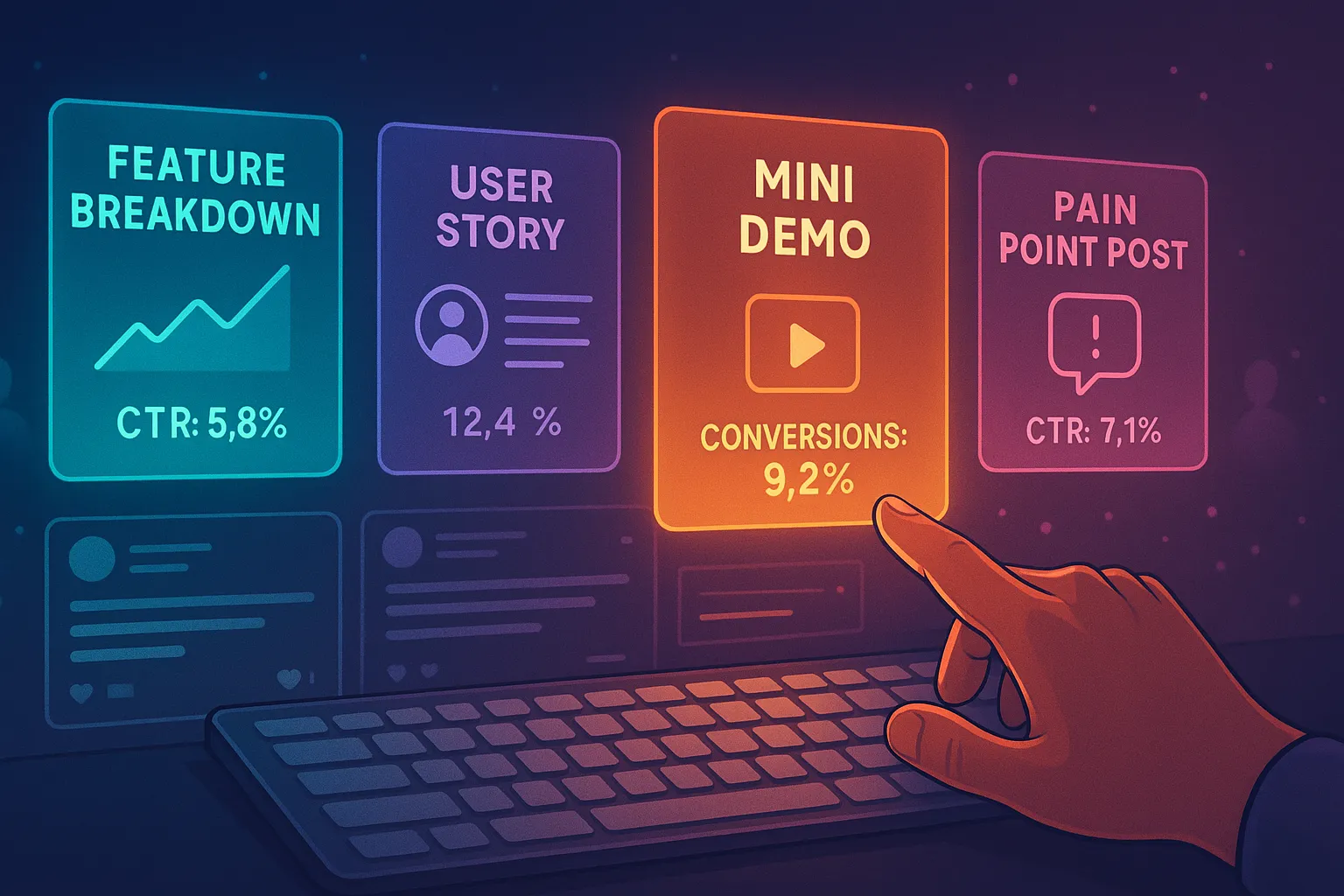
Static screenshots may look good, but they rarely convert on their own. Product content performs better when it shows the product doing one job clearly.
High converting product in context posts:
- Focus on a single workflow such as handoffs, reporting, or onboarding
- Use short captions that describe the before and after in plain language
- Highlight visible outcomes like fewer steps, shorter cycles, or cleaner data
- Link directly to a trial, demo request, or live walkthrough
Short clips or carousels can walk through the workflow in under a minute. The goal is to make one use case feel real, not to show the entire platform.
5. Use social proof and educational content to reduce risk
Your buyers already juggle many tools. Social proof and education reduce the perceived risk of adding yours.
Social proof that moves buyers to action
Social proof works best when it is specific:
- Short quotes that mention a clear result
- Mini case studies with problem, solution, outcome
- Screenshots of unsolicited praise from communities or internal chats
Instead of listing logos, explain what those teams actually achieved and what changed in their day to day work.
Educational content that leads naturally to signups
Educational content converts when it is practical and close to your product category. Useful formats include:
- Simple frameworks for a recurring problem
- Checklists or templates that teams can apply immediately
- Carousels or threads that break down a process step by step
At the end, add a natural offer such as “We will apply this checklist to your workflow on a 20 minute call” or “Get the full template and setup guide when you sign up here.”
Final Tips for Social Media Content That Converts
Treat social content as a system, not a set of one off posts. Start by defining your key conversions, then build a repeatable mix of founder insights, problem to solution stories, product in context clips, social proof, and practical education. Give each post one clear job and one clear next step, and judge its success by the demos, trials, and serious conversations it produces, not just reach.

Book an Intro Call
Frequently Asked Questions
A conversion is any action that meaningfully moves a potential buyer closer to becoming a customer. Common examples are demo bookings, trial signups, requests for pricing or security details, or serious direct messages from people who match your ideal customer profile. Engagement metrics help you see what resonates, but they support these higher value actions rather than replace them.
Yes. Brand accounts are useful for consistency, product updates, and housing resources like case studies and how to content. Founder content often sparks conversations and builds trust, while brand content can keep prospects informed and supported. The strongest results usually come from both working together.
A good starting point is three to five posts per week that clearly tie to conversions. For example, one or two founder posts, one story based example, one product in context clip, and one educational piece. It is better to maintain a steady rhythm of high intent content than to post daily without a clear goal.
For B2B SaaS, LinkedIn is usually the main conversion channel, especially for founder posts, case studies, and product in context content. X can work well for technical or early adopter audiences. Short form video on TikTok, Reels, and YouTube Shorts is useful for awareness and brand, and can support your main conversion channel by sending more people into your funnel.
You can see early signals within a few weeks, such as better quality replies and a handful of demos. Building a reliable pipeline from social usually takes a few months of consistent posting, testing, and tracking which posts lead to real calls, trials, and deals. Over time, clear patterns emerge around which topics, formats, and voices convert best for your specific SaaS.